The problem
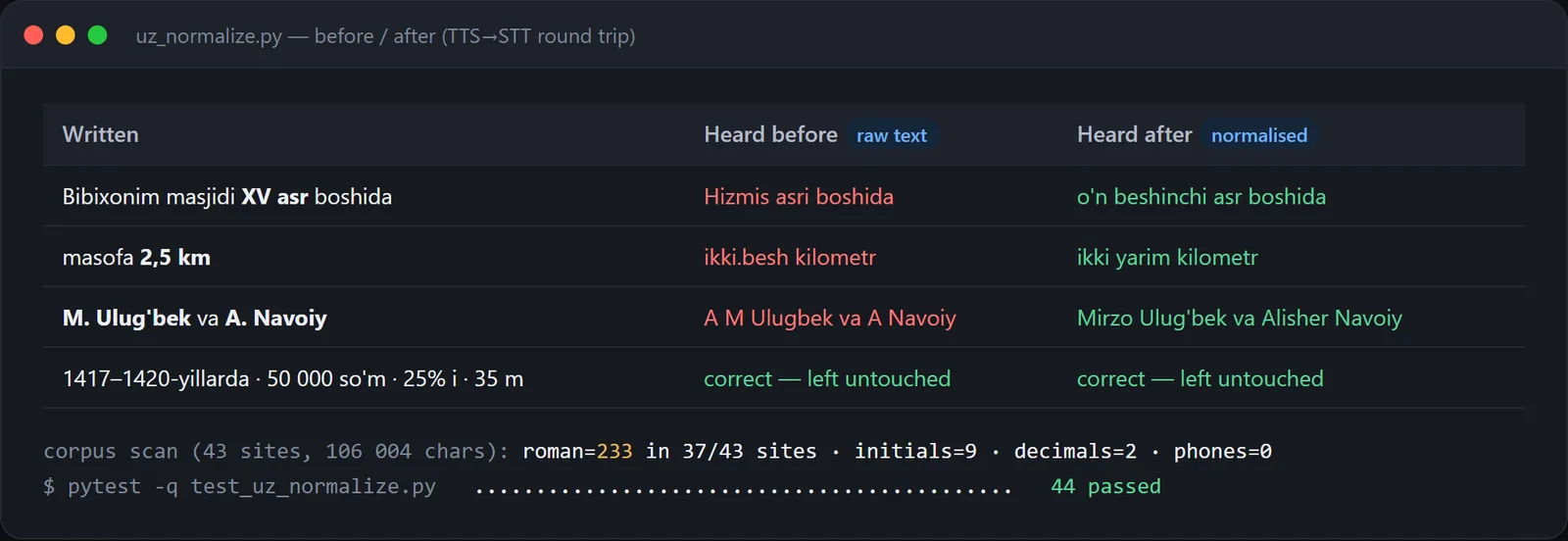
Synthesising narration for 43 heritage sites, the Uzbek voice read “XV asr” as letters, “2,5 km” as “two five”, and “M. Ulug’bek” as “em Ulugbek”. Historical text is full of these: one Roman numeral every ~455 characters.
What I did
- Measured instead of guessing: scanned the full corpus and counted the patterns (233 Roman numerals, 9 initials, 2 decimals, 0 phone numbers).
- Designed a 24-sentence probe across numbers, dates, money, units, Arabic names and four apostrophe encodings; listened, then confirmed objectively with a TTS→STT round trip (noting that STT adds its own errors — the ear is the final judge).
- Wrote a normaliser that touches only what the engine gets wrong: Roman numerals → ordinals with
context (
asr,bob, ranges likeXIV–XV), decimals → “ikki yarim”, initials → full names from a dictionary or surname only, phones grouped with leading zeros. Years, money, percentages and units are deliberately left alone. 44 tests. - Re-synthesised and verified: “o’n beshinchi asr”, “ikki yarim kilometr”, “Mirzo Ulug’bek va Alisher Navoiy” — correct.
- Sent the vendor a two-page memo with the probe set, scope numbers, the module and before/after audio.
Why it is here
It is the shape of work I want to do: a real production problem, a measurement, a fix with tests, a verification method with known limits, and a write-up someone else can act on.